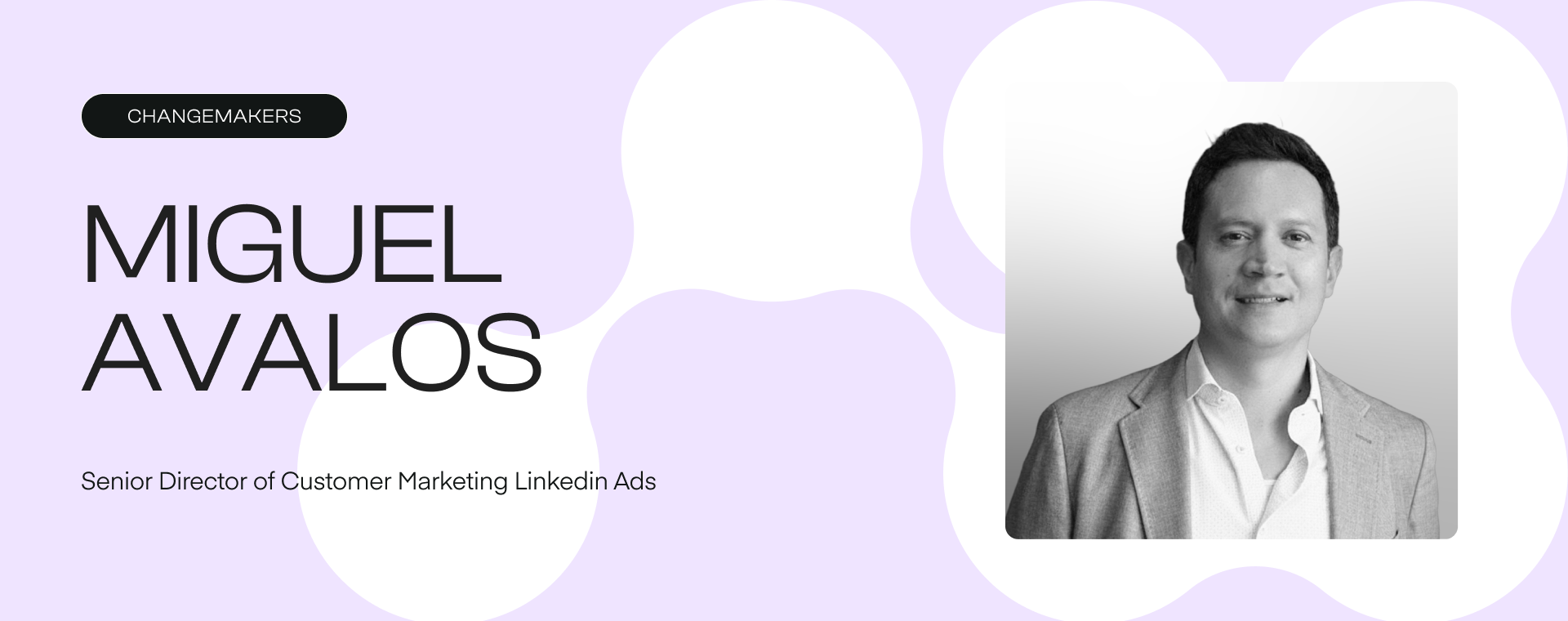
My name is Miguel Avalos. I work at LinkedIn, where I lead the global customer marketing efforts we run as a company for our advertising business.
That means helping customers grow from small to big, and doing that in different formats – from running ABM programs, executive engagement and big tent-pole events to webinars and scaled programmes. It is really about making sure customers have a place where we can engage with them on an ongoing basis, and that we can help them grow using the latest from our products, as well as the trends and information we can share.
I have been at LinkedIn for a year and a half. Before that, I started my career more than 20 years ago as an entrepreneur. I then moved into sales at Procter & Gamble in Latin America, worked in global strategy for Samsung Electronics in South Korea and later moved to Eastern Europe, to Poland, where I joined Google.
Since Google, I have been focused on B2B. But as you can see, my background also includes B2C, strategy and sales.
How do you see your role as a marketer in driving broader industry or sector change within your space?
Given my background, I’m lucky to have a perspective on a lot of different things. I’ve seen how go-to-market motions work in different parts of the world and in different industries. Sometimes you have to be more scrappy, and sometimes you have a little more budget. For me, that understanding of the bigger picture helps me constantly test best practices and push the way we think about things, ensuring there is brand or commercial value out of it.
Equally, my background in sales and strategy positions me to help the industry change in a different way, because there is still a lot of opportunity in B2B.
There is also the fact that I work for LinkedIn, which is a massive platform for B2B. That gives me a way to amplify what I know and my skill set, because LinkedIn has a particular focus on B2B. When you think about advertising, LinkedIn also performs very strongly in terms of trust and preference. We see very high intent from the B2B industry in particular, and as a company we believe we have an opportunity to shape how B2B operates because we have the technology, the talent and insights from our Economic Graph about what is happening around the world.
People obviously think about LinkedIn in terms of talent and jobs, but the reality is that you can combine all of that with our other product lines across sales, marketing and consumer. That gives you a very good picture that you can use to become a better B2B marketer and advertiser.
What's the most provocative idea or strategy you've implemented in your B2B marketing, and what was the response?
That’s a very good question. I was thinking about it, and I think there are a few examples with a common theme. But I’ll go with a recent one because that makes it more relevant: our activation at NewFronts in the US.
For those who may not be familiar with it, NewFronts is organised by the IAB in the US. It is a week-long series of shows and events involving the different suppliers in video advertising, mostly focused on digital. It has been around for close to 20 years.
What we did at NewFronts reflects something I have consistently seen in meaningful and bold campaigns: the importance of integration. As a marketer, you should think not only about what your own team is doing, but about the bigger picture. How do you orchestrate with other teams? How do you work with sellers to make sure you are landing different things with customers? It is about bringing all the arrows together and pointing them in the same direction.
For NewFronts, we launched a new US brand campaign called “Cut the Bull Spend”, which was a play on “cut the BS” when it comes to advertising. We had seen that there was a lot of wastage in how customers invested in advertising. At the same time, we had proof that LinkedIn delivers a higher return on advertising spend for B2B than our competitors. The campaign was a way for us to make a statement.
During that week, we activated the campaign through out-of-home and digital media. One of the more creative elements involved taxis carrying the “Cut the Bull Spend” campaign. We may also have accidentally parked some of those taxis outside our competitors’ events at NewFronts. That was such a good idea, bold, funny, and made a point in a catchy way.
Taxis carrying the “Cut the Bull Spend” campaign.
Kudos to Keith Browning, he is part of the integrated marketing team and was the mastermind behind it.
That was just the brand campaign, which we also replicated in India, Germany and the UK. During NewFronts, we had our own event as well. The difference was that it was not only a customer event – it was a show. You need to showcase the best of what you have in less than 60 minutes.
We had a packed room of 300 customers, and it was about bringing everything together. It was more like putting together a movie, with all the moving pieces, making sure people had a memorable experience and that the messaging cut through the noise.
On top of that, we had webinars, events in a box and sales follow-up. It was a full campaign with the wider company behind the initiative, and that is what made it very different.
At the event, we wanted to make the point about video and how we are working with creators, so Corporate Natalie was our MC for the night. We also had Ryan Reynolds, who has done amazingly well not only as an actor, but with all the businesses he has built or helped to grow. We had a panel with him and our CMO, where they spoke about Wrexham.
All of those elements and that wider story coming together made the activation a massive moment.
Can you share an example of how you've used storytelling to shift perceptions in your industry?
To keep things simple, I’m going to stick with NewFronts as the example, because I think it brings together many of the elements you see in good storytelling.
Our goal was to shift perceptions of LinkedIn as a talent solution, rather than as an advertising solution for advertisers. We needed people to understand that we are an advertising solution, that video is growing on LinkedIn and that we are serious about playing in that space.
Last year, it was more about making the statement that we had started doing something in video. We were relatively new in that area. This year, we came back to show what we had done, share the proof points and demonstrate that we are now a serious player in video.
When you think about storytelling, you need to define the job to be done very clearly. You should be able to explain in one sentence what you want to achieve. That became the foundation of the whole campaign. From there, we had different messages landing across different channels. Some were more product-related, while others connected to the “Cut the Bull Spend” campaign and the return on advertising spend. But first, you need to nail the overarching story that everything else can cascade from.
For me, the recipe for good storytelling starts with understanding the tension. That is particularly relevant now, when marketers and senior leaders are trying to navigate AI and understand what it means for them.
For me, the recipe for good storytelling starts with understanding the tension. That is particularly relevant now, when marketers and senior leaders are trying to navigate AI and understand what it means for them.
Then you need to explain why video matters in that context. Video is our fastest-growing format. People engage with it more and share it more, while creators are also becoming increasingly important. It is almost like a marketplace: you have people creating the content and people consuming it. From there, you can introduce the product innovation, success stories and proof points.
The other important part is making the story memorable. You need to find the element that is going to stick, whether that is an analogy, a use case or something else. For us, Corporate Natalie and Ryan Reynolds helped connect that thread and make it memorable. We also wrapped up the event by randomly giving three people tickets to travel to Wales and watch a Wrexham football match. You met Ryan, you saw Wrexham, and you heard the story. Now you could go and actually see the game.
I think that is what the process comes down to: understanding the problem, making it memorable and building a story around it. You also need to show how you are solving the tension that exists.
I think that is what the process comes down to: understanding the problem, making it memorable and building a story around it. You also need to show how you are solving the tension that exists.
In your view, what do you think is the biggest change needed in B2B marketing right now?
I think B2B marketing needs bolder ideas.
Sometimes it feels like B2B is stuck in the past. That is not true of everyone, by the way. There are lots of great examples. ServiceNow is doing a great job, and there are younger or start-up companies doing a lot of interesting things as well, or big financial institutions.
But generally speaking, I think there is still an opportunity for the industry to be bolder, to cut through the noise and to be a little more provocative. People already know how to measure, and they understand the business because it is B2B. But sometimes it still feels like we are stuck in the past.
How do you encourage your team or organisation to think boldly and embrace change in their marketing approaches?
I hope this does not sound clichéd, but especially in changing times, it becomes even more important to get to the core of the customer insight. What are we trying to solve? Five years ago, nobody was thinking about large language models, and even two years ago, they were not part of most conversations. Now AI is transforming things. For some people, the focus will be large language models. For others, it will be agentic AI. There are different levels to how people are thinking about AI in general.
You always need to stay on top of what is happening with customers and what the wider trends are, and then get to the core of that insight. Once you have a clear understanding of the problem, identify what will move the needle and how you are going to solve that pain point.
Then you can push new thinking. You need to reconsider whether what you have done in the past is still applicable or whether you need to change the approach. The final part is embracing AI in whichever form makes sense. It might be as a thought partner, a way to become more productive or a tool for creating something new. On the creative side, you need to use AI because, if you are not, someone else will already be using it to become more effective.
What do you think, in one word, makes B2B marketing changemaking?
Trust.
I think trust is at the core of B2B marketing.
B2B has traditionally relied on trust and word of mouth. You know someone, they introduce a salesperson or a brand to the wider buying group, and that group is unlikely to make a purchase decision if they do not know or trust the brand.
Trust has always been important, but I think it is becoming even more important today because relationships are not always built face to face. They are also built online.
Trust has always been important, but I think it is becoming even more important today because relationships are not always built face to face. They are also built online.
In the context of large language models, people are looking across different signals, websites and pieces of information. Creators are playing a similar role because they help brands build trust and credibility. So, if I had to summarise what makes B2B marketing changemaking in one word, it would be trust.
What is your one piece of advice to future Changemakers on how to be more effective in B2B marketing?
At the risk of sounding repetitive, more than ever it is important that we understand the core of the problem and go deeply into the insight. What is the pain point we need to solve?
Sometimes it can be the product, sometimes it can be time or friction, and sometimes it can be a lack of understanding, education or awareness. If you do not know that at the beginning, then everything else breaks. You can come up with the best marketing ideas and have a healthy budget, but if you do not actually understand the problem, then it is useless.
I think that is the foundation. The insight has to be relevant, and once you have that, you can move into the other things and, as I mentioned, embrace AI and be bold. I think those three things would be my advice.
Changemakers spotlight innovative B2B marketing leaders who are driving industry transformation, where we explore bold strategies, disruptive ideas and the power of marketing. Meet more Changemakers here.
INSIGHTS
More Insights from alan.
To re-form your industry, we must re-form ours first. From our visceral point of view on creativity to our incisive approach to strategy, delve into our provocative thought-leadership on how we’re aiming to subvert B2B’s status quo.