Tell us about yourself.
I'm a marketer who comes from a brand background. I started as a brand strategist straight out of university, having studied history, not the obvious route into brand, but the appeal for me was always that brand sits in the middle of culture, psychology and business, with a creative element that suited my background too.
I loved it from day one. I spent a few years as a strategist, then went in-house at a few early-stage start ups in various marketing roles, at a time when the London tech scene was starting to kick off.
After awhile, I wanted broader experience, somewhere product-market fit had already been established, with budget, structure and people to learn from. So I joined Trainline as a brand manager. Initially I worked on the UK business, which was a brand-love brief, since awareness was already huge and the focus was on giving consumers reasons to love us. When Trainline moved into Europe, I moved to the international side and worked on the European brand launches across different markets, which was fascinating.
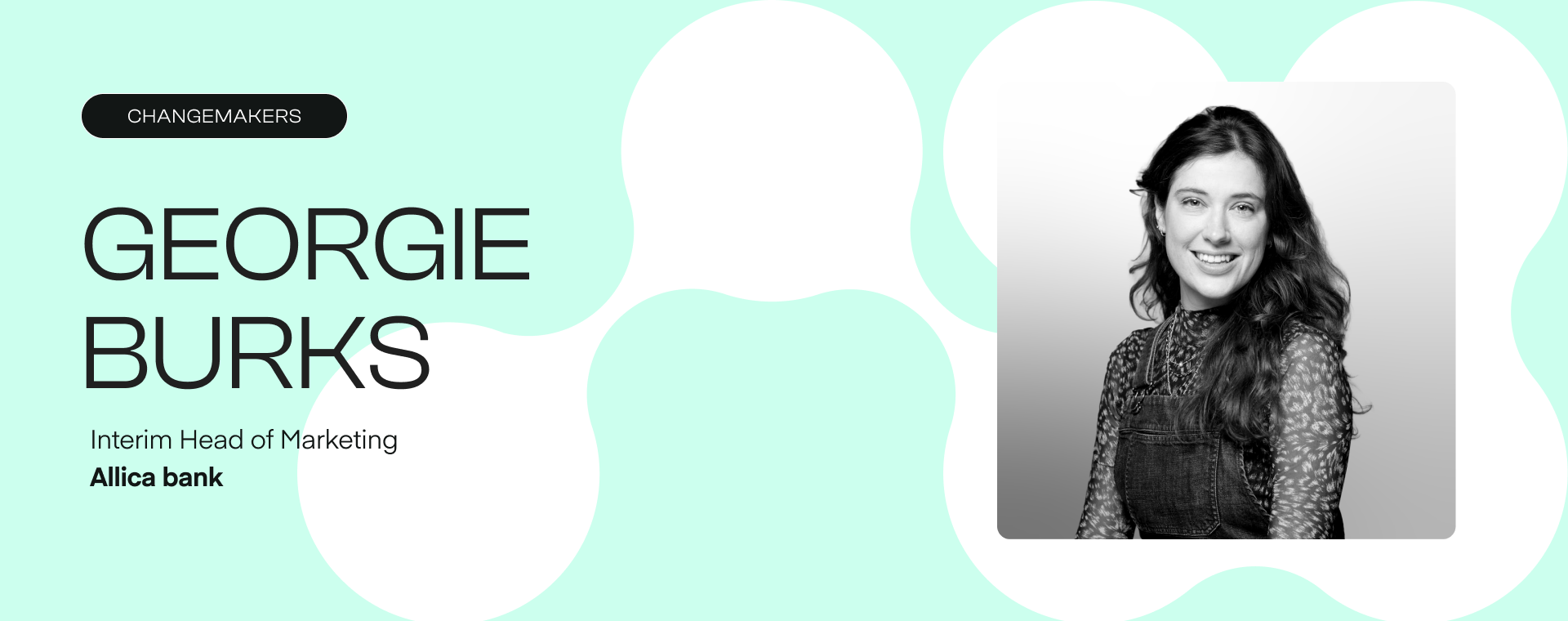
I've now had two roles in fintech, and Allica is the current one. I've led the brand brief there for two and a half years, and I'm currently covering the Head of Marketing role.
How do you see your role as a marketer in driving broader industry or sector change within your space?
I see the role, particularly at Allica, as category change, not creation exactly, but alerting the category to the disruption that's happening right now.
That's really the job of marketing. There's so much inertia in our segment, people are more likely to get divorced than switch bank accounts. So, our job is to make them rethink their banking choices. A lot of that comes down to inserting yourself strongly into people's minds as a reason to think about something they're not thinking about.
What's the most provocative idea or strategy you've implemented in your B2B marketing, and what was the response?
The orange bowler hat.
I'll be honest, I was very nervous about that. I'd never worked with a distinctive brand asset in the form of a mascot or icon before. It's quite an old-school approach, think Direct Line, or in banking, there are plenty of examples: the horses, the meerkats, all that sort of thing. But I'd never worked with one, and an orange bowler hat is a genuinely difficult asset to work with.
We tested it heavily before committing to it long-term, which was reassuring. But during the rebrand itself, I felt nervous about how hard it is to make something like that look tasteful, interesting and still clearly a bowler hat.
It was a bold move, but it paid off. As we tested and rolled it out, we gained far more conviction in it, and I've since learned a huge amount about the benefits of having a distinctive brand asset like that.
Can you share an example of how you've used storytelling to shift perceptions in your industry?
I'd point to two thought leadership storytelling pieces we've run.
The first is around the savings discrepancies SMEs face, the interest rates offered to SMEs are far lower than those offered to corporate customers. There's a massive gap in what British SMEs receive from the big banks in interest payments compared with their corporate counterparts. We've been running a piece of work called the Great British Savings Squeeze since I joined, for nearly two and a half years. Every month, we benchmark our savings rate against the big banks and quantify how much SMEs are losing out on nationally. It's been a really useful anchor — not just to call out bad behaviour, but to position us as the champion of SMEs in the UK. We feed that data into our public policy work and run an extensive PR strategy around it, across local trade, national press and beyond.
More recently, we've done something similar with the lending gap. There's been a big retreat from lending to SMEs, and it's twofold: a risk appetite issue on the banks' side, born out of regulation since 2008, and a confidence issue on the SME side when it comes to seeking funding. We ran a significant piece of research, pulled together by our CEO Richard Davies, and the findings are stark, especially set against how the UK compares with the rest of Europe.
It's a huge story that isn't being told enough. Given how much discussion there is about the UK's growth challenge, this is a big piece of that puzzle, SMEs contribute 30% of GDP, and if they can't access the lending they need to grow, that's a real drag on our economic momentum.
Where this fits into the broader marketing picture is that Allica takes a challenger brand mentality, a David and Goliath relationship with the big banks. But to defend that position and take a genuinely anti-incumbent approach, you need substance behind it. There's no point telling an inert market "we're on the side of SMEs" if you're not backing that up with data and calling out bad behaviour. I see a lot of brands attempt the challenger positioning, but unless they're bold enough to actually call out the bad behaviour, it falls flat.
The data itself is useful well beyond PR, it feeds our public policy agenda, gets distributed through our sales teams, gets cut by region, and often becomes the basis for our direct mail and other comms. It gets repurposed across all sorts of channels, which makes it feel like one consolidated story rather than simply saying "SMEs are having a hard time" and leaving it there.
In your view, what do you think is the biggest change needed in B2B marketing right now?
Upping the creative game across B2B brands. This might be controversial, but compared with B2C, the quality of creative in B2B is about ten years behind. You're still talking to the same consumers, you need the same clarity of messaging and branding, and the same ability to bring it to life, as you would in consumer marketing.
You're still talking to the same consumers, you need the same clarity of messaging and branding, and the same ability to bring it to life, as you would in consumer marketing.
I do see good work, some brands appealing to microbusinesses, Xero for one, are making good strides. But across the industry as a whole, it isn't enough. You need to think through the investments you're making and how you're coming across.
There's still an assumption, one that filters down through boardrooms, that because we're in business, we'll all think rationally a hundred percent of the time, so a rational set of messages will do. That's just not how people work, psychology doesn't operate that way. You still have to think through behavioural biases and find your way in through them. Emotion is far more compelling than anything rational in brand building, so if you can find an emotive pinpoint for your brand, it will be more successful.
How do you encourage your team or organisation to think boldly and embrace change in their marketing approaches?
I can't take credit for this, but my boss, Conrad Ford, a seasoned fintech founder who now heads up our product strategy, has a phrase I like to pass on to the team.
"Be bold or don't bother." That's particularly relevant if you don't have a big budget. Someone once told me that bad creative decisions are incredibly expensive, you're spending on media, investing in everything else, and if the creative isn't good, it's money down the drain.
A previous boss once told me that if you're not a little nervous about an idea before it goes out, it's probably not ambitious enough. There's a boldness you need to aim for, and we certainly try to do that at Allica.
The other phrase we live by, which came from one of our PR agencies, is: "Go where the banks don't or won't." That fits our brand perfectly. We always ask: is this what a big bank would do? Then we steer clear of the big banking tropes and think about how a different kind of bank would approach it.
What does it mean to “build a brand”, and what have you learned from doing it step by step rather than launching everything at once?
You have to start with the ingredients of the business you're working with, what exists, rather than what you wish existed. Being clear on your point of differentiation is step one. Without that, it's easy to fall into the generic tech positioning trap of "insert industry made easy", travel made easy, insurance made easy, pensions made easy. It's such a common trope. You have to find what's beyond that.
At Allica, yes, we're making banking easier for SMEs, but it's how we're doing it that matters, that's the fundamental message. I spent a lot of time on that when I first joined.
Our first campaign worked, the media strategy delivered, but I was clear we needed to test: to get customer insight on their reactions to the creative, to different territories, and to the areas of differentiation I was observing, before going again. That's where the line "business banking how it used to be, just better" came from, alongside the bowler hat, both emerged from that first round of research.
We didn't rush straight into a rebrand from there. We spent another full year testing, which was difficult because I knew we needed to rebrand but the organisation wasn't ready yet. We wanted to get it right, and that year was well spent, refining and learning before committing to the rebrand and integrating the hat into the logo. We worked with external suppliers along the way, but ultimately did most of the rebrand ourselves.
We also worked hard on our tone of voice that year, something few brands actually take the time to define and own. I was genuinely pleased recently when a journalist described Allica as known for its witty advertisements, that's the tone of voice actually working.
We took a bit of a punt with our TfL campaign too, pulling it together in about two and a half weeks with very little stakeholder input, not by design, we were just moving fast, but it worked well. The pressure on me was far lower than if I'd gone in saying "we're doing a massive rebrand, here's the investment, what do you think?" Because it happened in small pockets, the pressure was off, and we learned iteratively in a way that made the rest of the work land.
What do you think, in one word, makes B2B marketing changemaking?
Funny.
Being humorous in B2B marketing is genuinely difficult, but it's also genuinely differentiating. If you can get it right, it's incredibly powerful.
What is your one piece of advice to future Changemakers on how to be more effective in B2B marketing?
Stakeholder management. I know that sounds a bit boring, but it's essential. You have to build trust and buy-in with your stakeholders, get it wrong early on, and it makes everything harder down the line.
You have to build trust and buy-in with your stakeholders, get it wrong early on, and it makes everything harder down the line.
Whenever I join a company, I map my stakeholder group: who I need to know to do my job effectively, what they need to know about me, and who to go to for what. Bringing people along the journey matters.
Most of Allica’s leadership team hadn't had much experience in marketing, so there was some nervousness early on. Conrad, who I report to, is really good at stripping out anything jargony or intimidating for people who aren't experienced marketers. Speaking in plain language and focusing on the absolute core of what needed to be shared was key to getting them onside early on in the process.
Changemakers spotlight innovative B2B marketing leaders who are driving industry transformation, where we explore bold strategies, disruptive ideas and the power of marketing. Meet more Changemakers here.