Tell us about yourself.
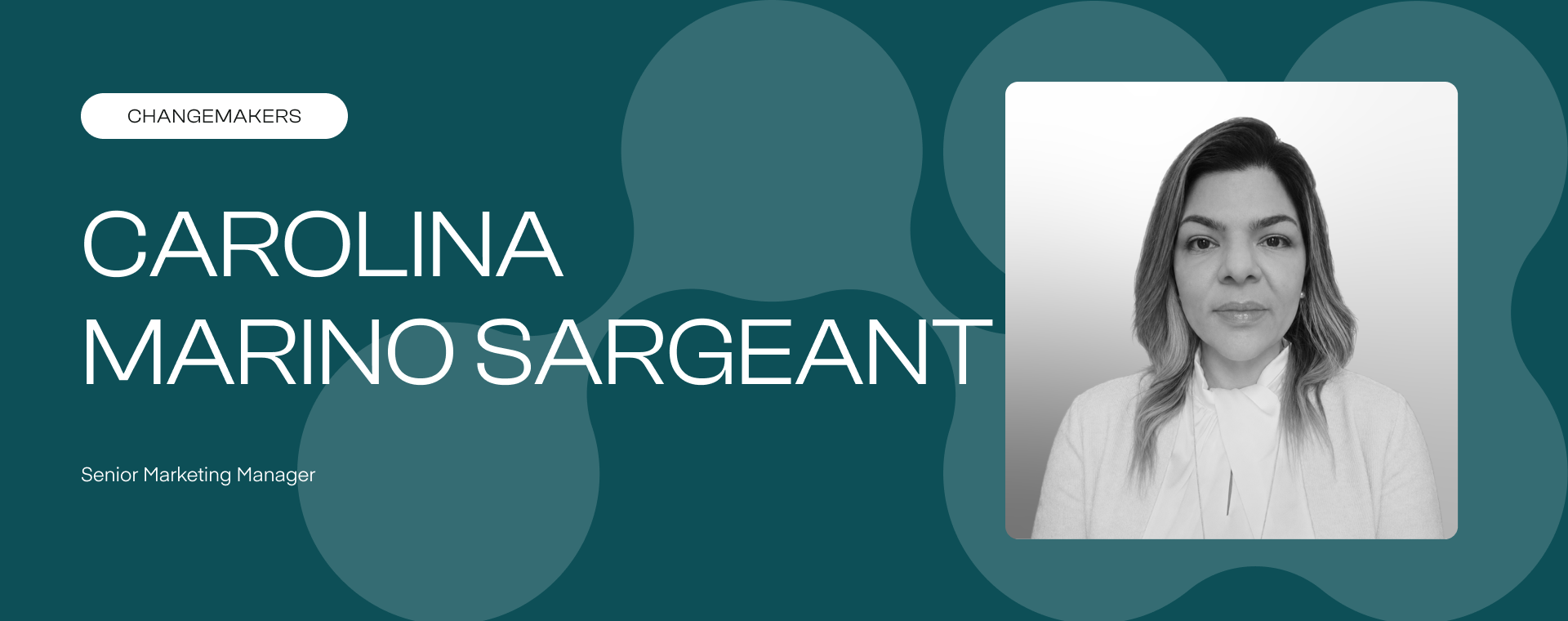
I’m Carolina Marino Sargeant. I’ve been working in B2B marketing for over 15 years.
I currently work at a Fortune 500 technology company. I’ve previously worked for companies including Cisco and F5 in the cybersecurity industry, and I’ve recently transitioned out of cybersecurity and more into marketing to marketers, which is an interesting space to be in.
How do you see your role as a marketer in driving broader industry or sector change within your space?
I see my role as a marketer, as an advocate for the customer. I want our customers to have a good experience when interacting with the business I’m working for. That means giving them access to accurate, relevant information that applies to their specific needs. I want to help them explore their own business goals more deeply, see what good looks like in their industry, connect with their peers, get practical examples of implementation and hear customer testimonials. Ultimately, I want them to buy products and services that actually meet their business goals, that make them look good with their managers, that make them excited to refer us to others. Sometimes, us marketers get so stuck into the daily work that we forget the customer is the star of the show.
Sometimes, us marketers get so stuck into the daily work that we forget the customer is the star of the show.
And what does this customer centricity look like in practice? Given the size of the organisation I work for, my role in B2B marketing is not just about planning and execution. Above all, I’m responsible for orchestration and integration. Nothing I do should be done in isolation. I am always working with peers across marketing so different functions and divisions know what each other is doing.
Digital needs to be working with Integrated Campaigns, Integrated Campaigns need to be working with Field Marketing, Field Marketing and Sales work as one team. Everything needs to be joined together.
Besides the waste of resources, the impact of not working together internally would be that we are all approaching the same customer multiple times, and leaving them with a terrible disjointed impression.
For example, I am currently focused on a set of accounts for a special programme, but those accounts are also targeted by industry campaigns, by digital, by BDRs, Sales, Solution Consultants, Customer Success. It is about taking advantage of all these interactions, inserting my initiatives into the right customer moments, maximising what is already being done, rather than reinventing the wheel every time.
It is also very important in my role to help others outside of marketing see the full scope of what we do, that Marketing is more than events and swag. There is a lot more happening than people realise, and surprisingly, we marketers aren’t always great at promoting our own work.
And when others in the organisation, especially leaders, don’t see the full picture, then marketing looks like an easy cut, or like something you can switch on and off. We often have budget cuts imposed at short notice, and have to scramble for creative ways to get things done. I learned a lot about leading by influence as I often need to convince people who do not work for me that what I need to get done is important, and that they should spend their own money and time to help me.
It’s not only budget cuts that throw us off course, sometimes we do get the opposite too. It’s what I call “magic money”, which is unspent budget that gets allocated to marketing halfway through a quarter and we then have 6 weeks to put a campaign together and spend it. If you are not prepared for this model of working, then everything becomes a fire drill. You operate under constant time and budget pressure.
If you are not prepared for this model of working, then everything becomes a fire drill. You operate under constant time and budget pressure.
As you see those cycles repeating, you start to prepare for those scenarios in advance. How would you prioritise? What can be cut if needed, what cannot? What is the impact of each of those cuts in your ability to deliver on your goals?
I build my plan with tiers in mind, and I’ve made a habit of saving budget and resources from the start. Could you find a colleague who has something similar and pair up with them, or insert yourself into a campaign that is already running so you do not have the additional cost?
I have, on many occasions, run entire campaigns with zero budget of my own, just by using existing internal resources, or borrowing from others’ budgets. I keep campaigns in my back pocket in case the budget is released halfway through the quarter, so I can activate quickly. I have already selected the agencies, I know they can deliver within the timeline and I have things ready to go if the incremental budget comes.
I also know the people who can find extra resources for me if something is really important. It could be a colleague in a different division, a leader, someone in Sales. Building those relationships early has helped me many times.
If you have a clear plan, clear priorities and you know the impact you are bringing, then you can articulate that story to other people. The better you are at showcasing the value of what you’re doing, to both the business and the customer, then the better your chances of getting support to get it done.
The better you are at showcasing the value of what you’re doing, to both the business and the customer, then the better your chances of getting support to get it done.
When it is really important, hopefully you will find a way to execute, even if it is not with all the bells and whistles you first thought of.
There’s a lot of talk about AI and yes, it has had a huge impact in how I work, but Marketing is no stranger to changes. In the past 25 years we went from business cards and licking envelopes for direct marketing, to adding in email marketing, web, digital displays, ABM. There’s always new tech and new trends, it’s part of the fun.
What's the most provocative idea or strategy you've implemented in your B2B marketing, and what was the response?
It is not particularly provocative, but part of my strategy is that I like to work as if I am part of the sales team. I love Sales, they tend to be pragmatic and focused on results, and they’re close to the customer, they understand their needs. When I work as a part of their team, attend their meetings, listen to their customer calls and ultimately, know what they’re working on, they see me as a peer, not a demand centre. I rarely get involved in any blaming games of who owns what part, we are all jointly responsible for the final outcome.
I always try to align myself to the same metrics they are focused on – ultimately bookings, pipeline and the same commercial outcomes. I think that helps. It is also about trying to give them structure. Instead of just saying no, I explain why something might be difficult to achieve from my perspective, so that in future they can help me with the timelines as well. The most common point of conflict is their last-minute requests.
By partnering with Sales from the start, I can suggest different ways to achieve the result they need, that may not be by doing what they asked me. I can anticipate needs, I can coach them on how marketing approval cycles and budgets work, and we can avoid operating in constant “fire drill” mode.
By partnering with Sales from the start, I can suggest different ways to achieve the result they need, that may not be by doing what they asked me. I can anticipate needs, I can coach them on how marketing approval cycles and budgets work, and we can avoid operating in constant “fire drill” mode.
For example, Sales may ask me to send out an email blast because that’s a tool they know, and it is my job to tell them if I think there’s a better way to do it, rather than just taking their request and running with it.
Some of the best sellers I know are masters at consultative selling. They understand customer needs and priorities before they pitch anything. I am applying that same principle. I have learned a lot from sales in that sense, because the good ones are natural storytellers. They try to find the root of the problem before positioning a solution, and I try to bring that into the marketing I create.
It has reached the point where I am in the sales team meetings, I am on their email distribution lists and when they have socials or team gatherings, I am included. They see me as part of the team. If you ask me who is working on what deal, whether something is about to close and what stage it is at, I know it because I am in those meetings.
I get really invested as well. When I see that they have an issue and marketing should be helping solve that problem, but we do not have the resources or the time, I will fight their corner inside my own department. I will try to identify the resources and accelerate the things that will impact their accounts.
At the same time, if I see that they are asking for something unnecessary, I do not feel like I am just taking orders. I can go back to them and explain why I am going to do something in a different way, or why what they are suggesting might not work. They will listen to me, because it has become a partnership.
You get out of that old model of marketing being seen as a demand centre or the “pens and events” department. Obviously, we still help with those things as well, but if sales need to do some ideation around a new account or find a way into a greenfield account, they bring me into those workshops. We think about things together because I am thinking from a different angle.
That level of partnership is important, but it does take time to build. You need to be in those conversations and understand what is going on in their world, even if you are not the one selling.
Can you share an example of how you've used storytelling to shift perceptions in your industry?
I recently worked on an account, supporting a deal with a large company. They had decided to take their creative in-house and have their own studio, so the people in the room came from agencies and very creative backgrounds. That made me feel like I needed to up my game. These are people who are used to seeing very cool work, and a boring PowerPoint presentation wasn’t going to cut it.
I worked with Sales to create a narrative for that specific customer. Sales wanted to acknowledge the customer’s own transformation, the change in their ways of working, and explain exactly how the products we were pitching would fit in their new reality. Our organisation had undergone a similar transformation, so we shared our own journey with them. It wasn’t a session talking about product features, it became more high-level about what motivated the change, exactly how the change was implemented internally, how the transition happened and what the business impact was. So it went beyond the “buy this product to fix the problem”, we wanted to demonstrate that the product was a tool, but it needed crafting around it for it to flourish into something meaningful for their business.
I then came up with the concept of origamis to represent that. A square piece of paper is the tech, the tool. It can be used for simple stuff, like writing your shopping list, or it can turn into a work of art. It was a good way to visually represent transformation, it reinforced the point that even good tech needs skills and a plan around it to work, and the graphics we created using our own tools also subtly showcased the product.
We built the whole presentation around that idea, using elements of the customer’s brand colours throughout. Using AI, we created a full London skyline made of origami that looked quite realistic, and I also had origami flowers physically in the meeting room in the brand colours, as a final touch.
The account manager explained the story as part of the pitch. It was not just origami for the sake of it, without context. Sales told the customer what it represented, what the idea behind it was, and how it fitted into the wider storytelling of the presentation. The origami metaphor gave Sales the tools to tell a bigger story, while connecting the physical space, the pitch and the presentation on the screen. It felt more immersive than a typical presentation.
The origami metaphor gave Sales the tools to tell a bigger story, while connecting the physical space, the pitch and the presentation on the screen. It felt more immersive than a typical presentation.
Also it wasn’t a one-way presentation, we gave lots of space for the customer to intervene, ask questions and help build the answers. We wanted them to feel a sense of ownership in the outcome of that meeting.
In fact, a lot of the one-to-one work we do is very hands-on and immersive. We want the customer to leave the room thinking, “They put real effort into understanding what our challenges are.” It is about helping people think creatively about their problems. It’s not only marketing, but our account managers and solution consultants also have access to storytelling training. It helps them be more strategic, zoom out of products.
A customer might come to us saying, “I have this one problem, and I think I need this one product to fix it.” But sometimes we can help them step back and think about the whole thing. This might solve the problem for now, but in a year’s time, will they need something else? What is the bigger issue they are trying to solve?
When you are too deep into a challenge, it is difficult to see the bigger picture. Storytelling tactics like analogies, giving examples, building a narrative from problem to solution helps the customer understand it and buy in.
When you are too deep into a challenge, it is difficult to see the bigger picture. Storytelling tactics like analogies, giving examples, building a narrative from problem to solution helps the customer understand it and buy in.
In your view, what do you think is the biggest change needed in B2B marketing right now?
Us B2B marketers need to get better at prioritising what we need to do. People keep saying that you need to prioritise, but then everything is important. There is always this pressure to do everything.
Marketing people in general, myself included, can be people pleasers. We want everybody to be happy. We do not want conflict. So we take on too much, and then it becomes really difficult to deliver quality or go deep into the detail of something.
If you are just moving from one thing to the next and only thinking about what you need to do right now, you do not have time to go back and analyse what worked in the past. You do not have time to revisit an event you did six months ago and ask: how is it performing? Has it brought any pipeline? Is it still being nurtured? What happened to the people who attended? How else did we engage with them?
You do not have time to do that sort of analysis if you are going from fire drill to fire drill. So I think it is about building the processes so that not everything becomes a fire drill. What is really important? What do you need to do right now? How do you still give yourself time to be creative, think about other things and focus on the work that actually matters? It is about doing the things that bring impact, rather than being busy for the sake of being busy. When you are just busy, you do not have time to zoom out. You are letting other people control your day and your workflow, rather than deliberately focusing on the areas where you can have the biggest impact.
It is about doing the things that bring impact, rather than being busy for the sake of being busy. When you are just busy, you do not have time to zoom out. You are letting other people control your day and your workflow, rather than deliberately focusing on the areas where you can have the biggest impact.
That is a skill we need to build over time: being able to say ‘no’ to people and explain why. You might need to say, “I am not going to be able to do this for you right now. I am focusing on this other thing instead, and this is the impact it is going to have.” Otherwise, you end up taking on too much and not doing the things that actually move the needle.
More and more, marketing needs to justify its impact on the business. How is it affecting the numbers? How is it engaging customers? How is it helping deliver results and build change? If you are not able to show that, even if you are doing the work, it becomes much harder to get more resources for the things that matter.
That adds to the continuous pressure of doing more with less – less budget and fewer people, but the same expectations. I think that is partly our fault as marketers for not articulating clearly enough what is working and what is needed. It takes a long time to change, and you need to deliberately think about impact.
Sometimes it is even about protecting your time. It might be a meeting where you feel, “I have been to this meeting five times before, I have never contributed anything, and I am just doing my emails at the same time.” You are there because someone sent you the invite and you feel like you should be, but it is distracting you from something else you could be doing.
Even protecting your time can help, but it is difficult. I am not saying I do this right all the time. I have the same problem as everyone else, but I think focusing on it is how we start to fix it.
How do you encourage your team or organisation to think boldly and embrace change in their marketing approaches?
From my perspective, I try to share my own views, share my ideas and speak up.
Some people might find it annoying and some people might find it refreshing, but I think it helps. Sometimes you can also be the voice of people in the team who have shared things they are struggling with, but do not feel comfortable speaking up in a meeting themselves. If you feel you have the space to speak up for them, it is important not to just let things slide or feel like those views are not being represented.
I try to work with transparency and accountability, but also give people space to fail and try new things. People who work in a culture of fear will play it safe. If they feel that speaking up, sharing a bold idea or trying something different is going to come back to bite them later, they are not going to do it.
So I think it comes from having a culture of trust and transparency. It is being able to say, “I am going to try this. I do not know if it is going to work, but I think it will, and these are the steps I am putting in place to give it the best chance.”
Sometimes, for reasons outside your control, something does not work. Sometimes you pick the wrong strategy and it does not work. But if you are in a place that supports you, you should be able to say, “I tried this, it was completely the wrong thing to do, I learned X, and I am going to do it differently next time.”
As long as you are not failing all the time, and you have other work that balances out those failures, it should be safe for someone to fail. That safety net allows people to be creative and propose ideas that are bold or different.
It is having the confidence that you can come up with a crazy idea and nobody is going to laugh at you, or blame you if it does not go right. So I think it comes down to culture, trust and having good leaders in place. That really helps foster creativity.
What do you think, in one word, makes B2B marketing changemaking?
Orchestration.
For me, that has been the underlying theme of B2B marketing. It is finding all the things that are happening and bringing them together, rather than doing anything in isolation.
What is your one piece of advice to future Changemakers on how to be more effective in B2B marketing?
Be organised. Learn how to say no, and don’t become driven only by someone else’s requests.
You need to have a clear idea of the priorities for your role and where you can make the biggest impact. Then you need to make sure most of your time is being spent on that, rather than on what other people think is important.
I am very good at asking other people to do things for me and getting my own work done through other people’s hands as well, so I know it works both ways. If everyone starts saying no, that is probably going to come back to bite me too.
But I think it comes down to being clear on what is going to bring impact, and focusing on that before you focus on other things. You also have to accept that you are not always going to make everyone happy.
Changemakers spotlight innovative B2B marketing leaders who are driving industry transformation, where we explore bold strategies, disruptive ideas and the power of marketing. Meet more Changemakers here.