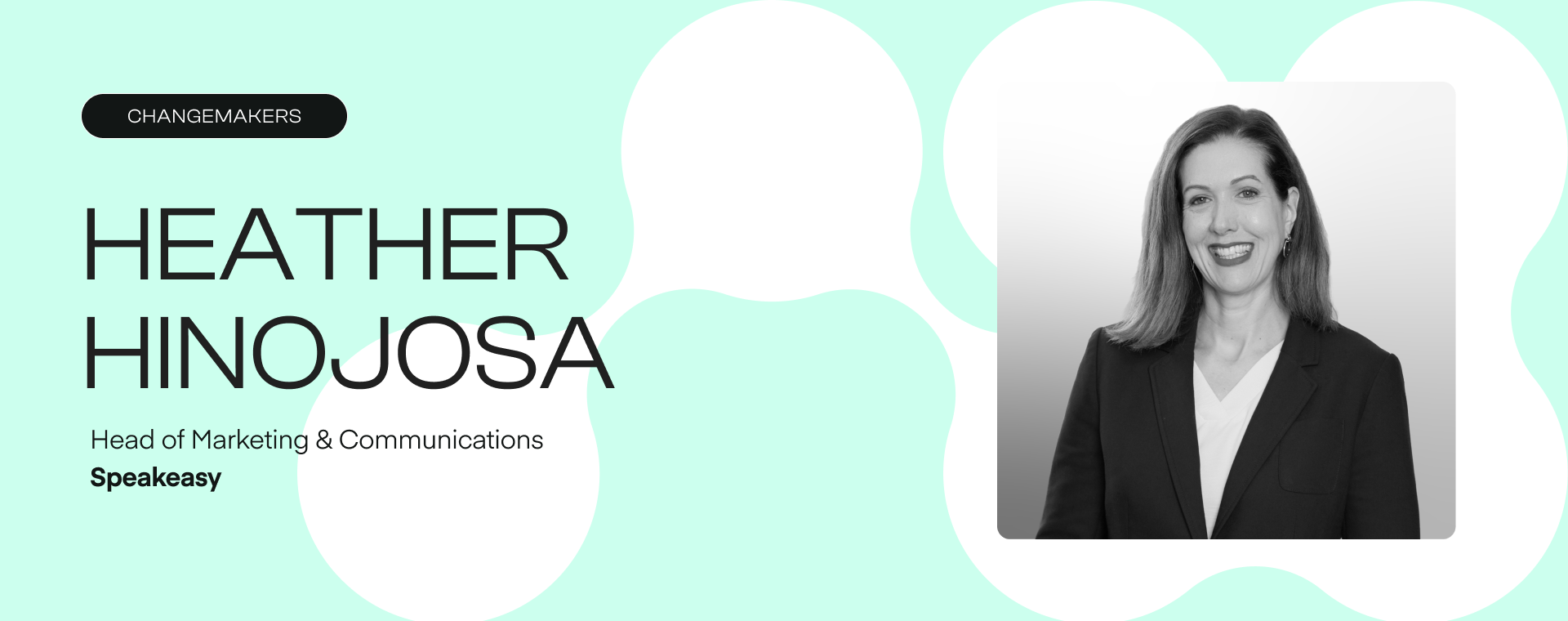
Tell us about yourself.
My name is Heather Hinojosa – I’m the Head of Marketing and Communications at Speakeasy – Speakeasy is an executive communication development firm located in Atlanta, Georgia, with locations across the US and in Europe.
What’s interesting about this company is that it’s been around for 53 years and has always relied on word of mouth but now they’re investing bringing in a marketing function to drive growth in other ways.
Previous to this role, I spent 15 years in B2B enterprise technology and healthcare technology positions.
How do you see your role as a marketer in driving broader industry or sector change within your space?
What I try to do as a marketer is translate solutions into something that leaders can understand, evaluate and act on. I think B2B marketers often underestimate how much influence they have on how an industry understands itself. They put the labels to things, the context, the frameworks.
And when you publish credible research, highlight real use cases and frame your solutions in practical terms, you help shape how leaders think about what’s possible – and what actually matters for their business. So in my experience, the role is less about promotion and more about sensemaking – helping people connect technology to real operational and business outcomes.
The role [of a marketer] is less about promotion and more about sensemaking
In a business that’s grown through word of mouth, a big part of the change I’m trying to make is around driving awareness beyond the audiences who already know you.
The companies that know us well come back to us, but expanding into new markets means trying new things – social media, paid activity, partnering with other organisations or publications and making sure we’re showing up where decision-makers actually are.
When I first started creating content strategy to reach executive audiences in 2021, the research said that a C-suite executive might have around 17 touchpoints before reaching out to a vendor. The last figure I saw was closer to 30. It’s really about understanding where your audience is and how you show up consistently, so that when they’re ready to move forward, they think of you.
What's the most provocative idea or strategy you've implemented in your b2b marketing, and what was the response?
One approach that worked really well when I was in my previous role was moving beyond the technology hype around digital twins and asking a different question – what measurable business benefits are organisations actually seeing from digital twins?
So instead of talking about features, specs or the “bells and whistles”, we focused on how it was actually driving value for the business.
We knew this was an enterprise-level solution, so the real audience was executives – they’re the ones who drive these decisions top down. So we focused on surveying 600 senior leaders globally. We didn’t just look at how they were adopting digital twins, but what outcomes they were seeing – things like productivity, decision-making and reduced carbon emissions.
What was interesting wasn’t that technology adoption was growing – we know that – it was that companies using the technology were reporting measurable improvements in areas like operational efficiency and cross-team collaboration.
That shifted the conversation from an interesting piece of technology to a strategic business capability. Depending on who your audience is, you have to think about their pain points. An engineer wants to know how it fits in and how it helps their job. But an executive wants to know how this helps drive the bottom line.
I think a lot of marketers have the right intention – they want to prove value and speak the customer’s language – but it’s very easy to default to features and specs to make internal product teams happy.
When you put yourself in the customer’s shoes, especially at an executive level, they’re not asking for a spec list first, they’re asking how this actually impacts the business.
An engineer wants to know how it fits in – but an executive wants to know how this actually impacts the business.
Can you share an example of how you've used storytelling to shift perceptions in your industry?
The digital twin report is a good example.
We created a matrix with two continuums – one from not using the technology to more advanced use, and another from not getting value out of it to seeing improvements in things like productivity or carbon emissions. We then plotted 11 different industries within that matrix to see where they fell.
It was a really nice entry point into the story of digital twins, specifically through sectors. For example, we found that public safety was deriving the most value and was the most advanced in how it was using the technology.
So we built user stories around each of those quadrants, and it became a way to talk about how organisations were actually using it in their specific use cases to solve real problems – whether that was manufacturing, managing infrastructure or simulating decisions before committing resources.
It also allowed us to have more honest conversations. Not everyone was at the top in terms of adoption and value. Construction was much lower down, and we learned there was an aversion to the term “digital twin”. They are adopting the technology – it’s just the way we’re talking about it that created some hesitation.
So when leaders see how their peers are solving similar problems, the technology doesn’t feel abstract anymore, it becomes something they can imagine applying in their own organisations.
In your view, what do you think is the biggest change needed in b2b marketing right now?
I have a lot of feelings about this!
I think the biggest shift needed right now is moving away from volume and toward credibility. There’s so much content being created – especially with AI – but very little of it actually helps leaders make better decisions.
It’s very high level. I sometimes don’t think it talks to people how they really talk. I don’t read it and feel like I got smarter! It’s a lot of jargon and I have to parse through it.
So I think the most effective marketing is grounded in evidence – using research, real use cases and honest discussions about what works and what doesn’t.
When marketing becomes a source of insight – where you actually learn something and can do your job better because of it, instead of it just being promotion – that’s when it starts to earn trust.
I do think part of the challenge is how we measure things. You want impressions, engagement, you want to see that it’s being shared – but a lot of the time you’re not seeing how it actually drives value.
‘Dark social’ is a real thing. We can see that someone liked something, but we don’t see that they shared it internally, or that it sparked a conversation, or that someone heard about it at an event and then reached out. I feel like that happens much more often – it’s just not trackable. So you end up having to capture that more anecdotally, rather than relying on surface-level metrics.
We need to move away from volume and towards credibility
How do you encourage your team or organisation to think boldly and embrace change in their marketing approaches?
One thing that I always do is bring stakeholders in early when we’re developing major initiatives. If you bring them into the thinking process – whether that’s product teams, sales teams – they’re much more likely to contribute ideas and then support it when you ship it into the world.
It also makes the work stronger because you’re drawing on multiple perspectives, rather than marketing working in isolation. You need those other people to poke holes in it – kick it around and see where it’s not working.
When I was in my last role, I didn’t have access to many salespeople. Now I work much more closely with them and it’s helped me so much.
Of course, talking to customers is the most important thing, but having access to salespeople and understanding what works for them – what the objections are, how they overcome them – and taking that into your marketing messaging, I think that’s huge. I don’t think we do it enough.
Sales is such a wealth of knowledge. In a technology company especially, they’re taking quite technical information and distilling it for customers – so in a way, they’re doing that work for you as well. It’s almost like a cheat sheet.
What makes b2b marketing changemaking?
Clarity.
I think that when leaders understand a problem and the options available to them, they can make better decisions. With AI and so much coming at them, I don’t think we’re making it easy for business leaders to make decisions these days. If you can be very clear, you’re going to break through all the noise.
What is your one piece of advice to future Changemakers on how to be more effective in B2B marketing?
If you're launching a big initiative – whether it's research, a report, new messaging, a new narrative – you cannot just talk to marketing, you have to roadshow it internally. You need to share the thinking with the sales team, with the product team leaders, executives and cross-functional marketers, show it to them on a regular basis and ask for their perspective.
When we did our first research report at Hexagon, the Autonomous Construction Technology report, we had roadshows when we first kicked off the initiative to say what we were doing, ‘these are the types of questions, the regions, the narrative we’re going for’ etc. At the end when it was ready, we put together a deck with the highlights; one for the leadership team, one for the sales organisation and one for the marketers, and briefed on it.
This was the most significant thing and that’s what made it such a success – everyone was using it in their social media, in talks that weren't even related to Hexagon, they were getting the opportunity to byline articles and they were doing all this because we took the time to tell them about it consistently and drive it home repeatedly.
For that report, I interviewed about nineteen salespeople who were client-facing to figure out the topics people actually cared about. So by the time that report came out, I went back to them, thanked them, and told them what an important role they played. Letting people feel ownership was the key.
Changemakers spotlight innovative B2B marketing leaders who are driving industry transformation, where we explore bold strategies, disruptive ideas and the power of marketing. Meet more Changemakers here.