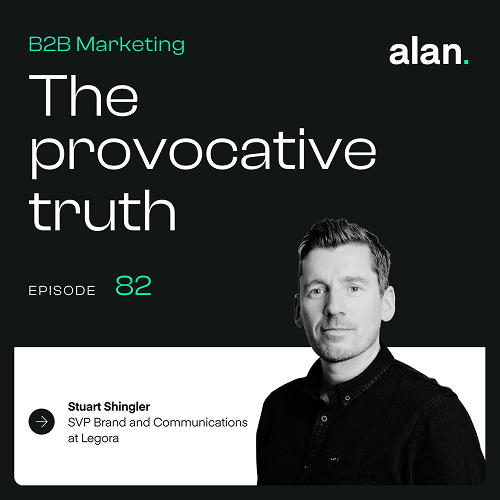
Why fear-led cybersecurity marketing stops working with Karl Van den Bergh, Chief Market Officer at Illumio

Karl Van den Bergh, Chief Market Officer at Illumio, argues that fear-led cybersecurity marketing wears out its welcome, and that brands win by pairing hard truths with agency and distinctive humour.
“We forget we're people. Even a CISO has humour"

Show notes
Fear gets attention. But what happens when every vendor in your category uses it, all at once, all the time? In cybersecurity, the answer is a market that sounds identical, feels ominous and gets tuned out by the very people it is trying to reach.
In episode 83 of B2B Marketing: The Provocative Truth, Benedict Buckland, MD of alan., is joined by Karl Van den Bergh, Chief Market Officer at Illumio, the cybersecurity firm specialising in breach containment. Together they test the provocative claim that fear as a device in marketing doesn't work.
Karl's answer is nuanced. Fear can work in the short term, because it gets people to act. But decisions made out of fear tend to be reactive, and when everyone says the same thing all the time, audiences switch off. His view is that fear can be used occasionally to point something out, but used continuously it loses impact. Benedict adds the psychology: without a route to action, people manage the emotion rather than the problem, and one of the easiest ways to do that is to ignore it.
The conversation starts with Karl's own title. He changed it from marketing officer to chief market officer because he sees the role as representing the market to the company and the company to the market. He also describes a love-hate relationship with the CMO role, citing short tenures in Silicon Valley and what he calls the CMO tax: the need to keep educating the board and executive team on what marketing is doing and why.
From there, Karl sets out how he wants cyber to be positioned: not as a negative thing to be managed, but as the guardrails that let organisations deploy AI with confidence. For Illumio, that means containing breaches rather than only trying to prevent them, and building resilient infrastructure.
The most practical section covers how Karl creates distinction in a sea of sameness. He favours humour, and describes campaigns built around elementary school children visiting a CISO and a deliberately boundary-pushing concept called Pants Down. He explains how he tested the ideas informally with CISOs, secured CEO sign-off and why he tells his team to push until he says no. He would rather people love or hate something than find it fine.
Crucially, the creative was not a standalone stunt. It grew out of a thought leadership platform called The Hard Truths, which used panels, research and editorials to start an industry conversation, then moved interested buyers into the demand cycle. Benedict draws out the lesson for B2B more broadly: top-of-funnel creative only builds the brand if it sits within a wider journey that gives people something to do next.
They close by asking whether the current AI moment will multiply fear in cyber marketing or galvanise people into purposeful action.
Bene and Karl discuss:
- Fear in marketing – why it works briefly, then loses effectiveness
- Agency over anxiety – pairing a hard truth with something the buyer can do
- Standing out in a homogenised category – humour as a route to distinction
- Thought leadership as a campaign engine – how The Hard Truths platform fed creative and demand
- The CMO role – why the job is misunderstood and tenures are short
- Cyber and AI – positioning security as the guardrails for AI adoption
Read the full transcript+
Key insights
- Fear earns attention but not loyalty. Used constantly, it homogenises a category and teaches buyers to tune out, so it needs to be rationed and paired with a clear route to action.
- A distinctive tone can be a strategic choice, not a risk to be avoided. In a category where everything is heavy and dark, something lighter stands out, and a polarising idea is better than a forgettable one.
- Creative works harder when it is anchored in a thought leadership platform. The Hard Truths gave the humour a point of view, and gave interested buyers a path from conversation into the demand cycle.
- Positioning can reframe a grudge purchase. Presenting security as the guardrails that let businesses adopt AI turns a negative to be managed into a positive enabler.
- Marketing leaders carry a duty to educate the boardroom. Bringing executives along on the rationale for bold work, and securing sign-off early, is part of making provocative campaigns possible.