What AI misses about customer insight with Frances Fenemore, Vice President of Global Demand and AI Transformation at Delinea
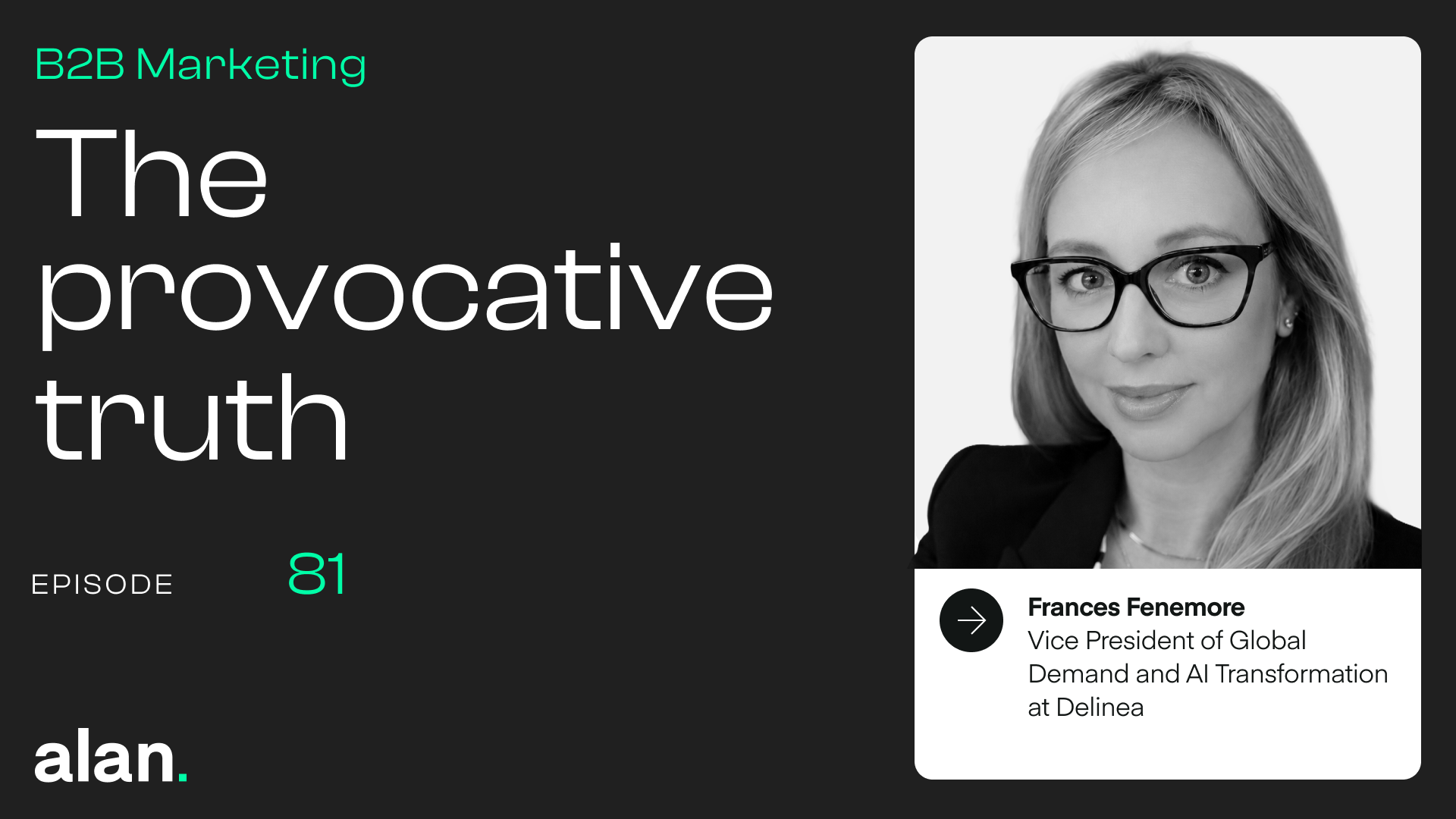
AI can analyse customer data, but understanding why customers behave the way they do still requires human insight. Frances Fenemore explores where AI helps, and where it falls short.
AI can analyse customer data, but human judgement reveals the why
Show notes
AI can analyse vast amounts of data, identify patterns and produce answers faster than any marketing team could manage alone. But can it really explain why customers behave the way they do?
In this episode of B2B Marketing: The Provocative Truth, Benedict speaks to Frances Fenemore, Vice President of Global Demand and AI Transformation at Delinea, about the limits of AI when it comes to customer insight, and why human judgement and emotional intelligence remain essential. Frances shares the thinking behind Delinea’s “Nothing Happening” campaign, which began with conversations with CISOs, customers, analysts and other people across the cybersecurity market. At a time when cybersecurity brands were competing to talk about AI, productivity, growth and securing the future, Delinea wanted to find a more distinctive way into the conversation.
The team took an outside-in approach, speaking to a wide range of people across the market rather than starting with a fixed agenda. What emerged was an unexpected emotional insight: while most business leaders are looking for positive outcomes, a CISO’s definition of success can be the absence of an outcome altogether. If nothing happens – no breach, no disruption, no crisis – they are doing their job well.
That insight became “Nothing Happens”: an intentionally counterintuitive proposition in a market where everyone else was talking about what their technology could make happen. As Frances explains, the campaign focused on the emotional driver behind the customer’s needs rather than features, functionality or efficiency. The conversation then turns to what makes a genuinely useful customer insight.
Frances explains how repeated patterns across conversations can reveal a gap in the market’s storytelling, and how marketers can distinguish an interesting finding from an insight they can actually build a strategy around. Frances and Benedict also explore whether marketers are becoming too reliant on AI to understand their audiences. While AI can process enormous quantities of data and identify patterns at a speed humans cannot match, Frances argues that data provides the what and the how, not necessarily the why. Understanding context, emotion and motivation still requires human input.
Finally, Frances discusses Delinea’s journey towards becoming a more AI-native marketing organisation, including the decision to hire an AI marketing manager. Her role is not simply to introduce more AI tools, but to rethink workflows, processes, skills and how different marketing teams work together. The episode offers a more nuanced view of AI’s impact on marketing: not humans versus machines, but knowing where each is most valuable. And for Frances, there is an optimistic conclusion. AI could ultimately make marketing more strategically important, giving marketers more insight and data to bring to the leadership table
Read the full transcript+
Key insights
- Data isn't the same as insight. AI can process huge amounts of information, but understanding the motivation and emotional context behind customer behaviour still requires human judgement.
- Start with the customer, not the category. Delinea's outside-in approach helped uncover an insight that would have been difficult to find by simply analysing existing category narratives.
- The best insights can challenge category conventions. “Nothing Happens” worked because it identified an emotional truth that contradicted the dominant cybersecurity narrative rather than adding another version of it.
- AI should augment marketing, not dictate it. The opportunity is to combine AI's ability to analyse and synthesise data with human emotional intelligence, strategic thinking and judgement.
- AI transformation is an organisational question, not just a technology question. Becoming AI-native means reconsidering workflows, skills, roles and how teams collaborate, not simply adding more tools to the stack.