Break the rulebook: how marketing helped Legora become the fastest to $100m ARR and flipped the script on set with Jude Law
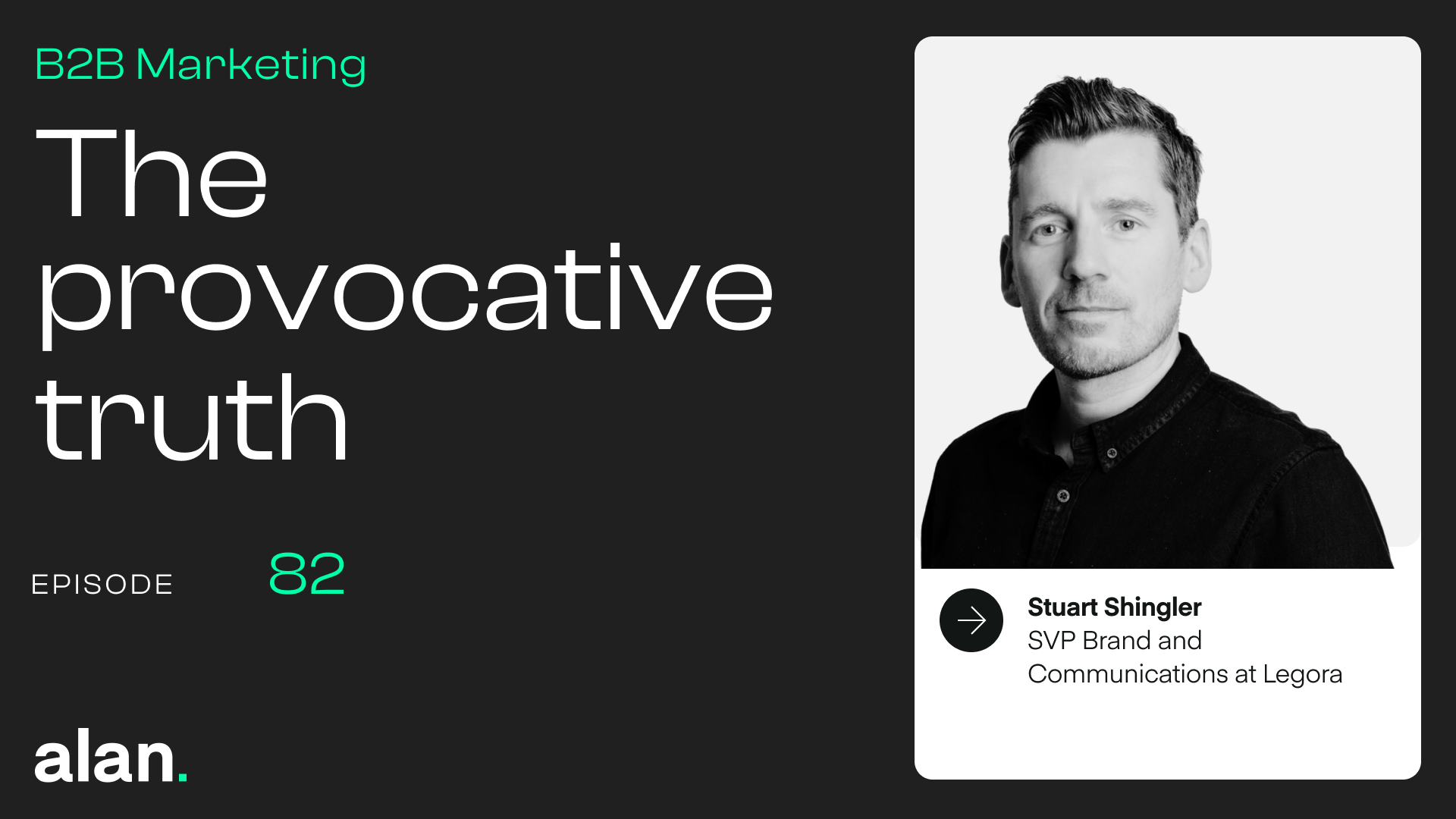
Stuart unpacks Legora's hiring philosophy of "high agency, low ego," and what incumbent marketing teams need to unlearn to compete with AI-native challengers.
"Your product isn't the advantage, your marketing speed is."

Show notes
Legora went from zero to $100 million in annual recurring revenue in 18 months. Stuart Shingler, its SVP of Brand and Communications, tells Benedict Buckland that the credit doesn't belong to the product alone. It belongs to a marketing function willing to throw out the rulebook.
The provocative starting point: established businesses aren't going to lose to tech scale-ups because their product is inferior. They're going to lose because their competitors can get an idea to market before they've even finished scoping it. Shingler agrees, but pushes it further. The real risk isn't just slower execution, it's a mindset problem. Fast-moving companies build with the assumption that what worked in the past can't be assumed to be as effective in the future, and that has to extend to marketing, not just product.
The clearest example is process. Traditional marketing runs in sequence: brand platform, then website, then messaging, then campaign. At Legora's pace, that sequence collapses.
As Shingler puts it: "Don't do things in sequence that you can do in parallel."
The team's Jude Law campaign is the case study. Rather than building the creative around a specific product claim that would inevitably age out before launch, they anchored it to something that wouldn't change: the emotional reason a lawyer would want to use the product at all. The actual product messaging was dropped into the script a week before filming, deliberately kept open until the last possible moment.
As Shingler explains: "If we'd set off on that route, we'd be marketing a product that was 10 months out of date."
That flexibility doesn't extend to quality. For an audience of lawyers, people whose job is to sweat the details, Legora treats craftsmanship as non-negotiable, from a full film crew and cinematographer on the Jude Law shoot to building a real pub for an event rather than a pop-up.
In Shingler's words: "We can't cut any corners in how we do any of our marketing or produce any content."
The conversation also digs into hiring. Legora onboarded 214 new joiners in August alone, all flown to Stockholm for a two-week induction into the company's values before touching any work. Shingler looks for a specific combination in every hire, regardless of department: "high agency and low ego," people who take ownership and push the work forward without needing to be the loudest person in the room.
The episode closes on the uncomfortable question for larger, established organisations: is your process protecting quality, or protecting the status quo? Shingler's advice isn't to copy Legora's speed wholesale. It's to interrogate every existing step and ask honestly whether it's still earning its place, especially as AI reshapes what's possible in every function, including marketing itself.
Read the full transcript+
Key insights
- The biggest competitive advantage a tech scale-up has isn't its product – it's a marketing function that moves at the same pace as the technology.
- Sequential marketing (strategy → positioning → campaign → launch) breaks down when the product is evolving in real time; work has to happen in parallel instead.
- Building a campaign around an enduring emotional truth, rather than a specific feature, protects it from going out of date before it airs.
- Moving fast is not an excuse to cut corners – for trust-sensitive audiences like lawyers, craftsmanship is itself a signal of product quality.
- Incumbents don't necessarily need to hire their way out of slow marketing; they need to question which existing processes still earn their place.